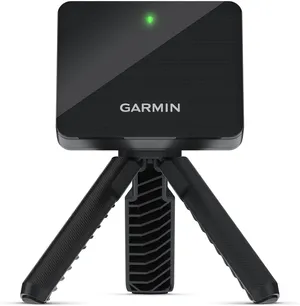
Garmin R10 specs
| Brand | Garmin |
|---|---|
| Type | Radar |
| Placement | Behind the ball: On the ground 6–8 ft behind the ball, with at least 8 ft from the tee to the net indoors |
| Room depth | 14 ft minimum, 16 ft comfortable. Garmin's manual: unit 6–8 ft behind the tee and the tee at least 8 ft from the net indoors, so 14–16 ft of hitting room before the net. |
| Use | Indoor & outdoor |
| Spin | Calculated from radar data, not directly measured |
| Club data | Path + face angle: Club speed, face angle, club path and angle of attack (radar-derived, approximate) |
| Putting | No |
| Balls / stickers | None: no stickers or special balls in Garmin's setup instructions |
| Display | None (phone or tablet app) |
| Battery | Up to 10 hours (maker rating) |
| Weight | 0.33 lb |
| Free to use | Garmin Golf app with driving range, training mode stats and shot video |
| Course play | Garmin Golf membership (Home Tee Hero) ($99.99/yr). $9.99/month or $99.99/year; 43,000+ courses on a phone or tablet |
| Third-party software | GSPro, E6 Connect, Awesome Golf. Garmin lists GSPro, E6 and Awesome Golf; third-party subscriptions are sold separately. Breaking Eighty says third-party use also needs the Garmin Golf membership; Garmin's pages don't say so. |
| Works on | iPhone/iPad/Android app; third-party PC software via the Garmin Golf app |
| Warranty | 1 year (Garmin limited warranty) |
| 3-year cost | About $800: hardware plus three years of the cheapest course plan |
| Price tier | $ Budget (under $1,000). See Amazon for today's price. |
- Garmin's manual allows the tee up to 1 ft either side of the target line, inside a 2 × 2 ft hitting area that starts 6 ft in front of the unit. If you hit off a mat, the bottom of the unit must sit above the mat.
- Garmin gives no ceiling figure, only 'ensure there is adequate ceiling height'.
- Plugged In Golf reports Garmin's published tolerances as club speed ±3 mph, ball speed ±1 mph, launch angle and direction ±1° (maker claims). It also got consistent data with only 6 ft from tee to net, below Garmin's 8 ft.
- Amazon showed $499.99 sold by Amazon.com on Nov 12, 2026 (list $599.99 at launch).
Specs come from the maker's manuals, FAQs and spec pages and from independent reviews; they can change with firmware and new bundles. Confirm what's in the box on the Amazon page before buying.
Garmin Approach R10 video review

Video by Breaking Eighty | Honest Golf Reviews on YouTube. Independent creator content, shown as a reference. It is not part of our scoring.
The Garmin Approach R10 is a pocket-sized Doppler radar that sits on the floor behind you and sends shot data to your phone. It costs about $499.99 on Amazon (Nov 12, 2026; prices change), sold by Amazon itself with 1,172 ratings, which makes it the most proven sub-$500 launch monitor we track. It’s also one of the cheapest ways into GSPro, E6 or Garmin’s own simulator at home.
Who it’s for, and who should skip it
The R10 suits golfers building a first home simulator on a tight budget who also want something for the range. It weighs 0.33 lb, it’s IPX7 waterproof and Garmin rates the battery at up to 10 hours, so it moves easily between the garage and the practice tee.
Skip it if your room is short. Radar units have to see the ball fly, and the R10 needs space behind you as well as in front. A side-of-ball unit such as the SkyTrak+ or Bushnell Launch Pro i fits shorter rooms. Skip it too if measured spin matters: the Rapsodo MLM2PRO measures spin with RPT balls for about $50 more. And if you mostly want numbers at the range with no phone and no plan, the Voice Caddie SC4 PRO is built for that.
Breaking Eighty’s August 2026 update sums up where the R10 now sits: still one of the best launch monitors under $1,000, but showing its age, with the MLM2PRO ahead on app and accuracy and the SC4 PRO ahead on value.
Key capabilities
For $500, the data set is generous. The free app shows club speed, face angle, club path and angle of attack, all radar-derived and approximate, plus automatic swing video from your phone’s camera. Plugged In Golf reports Garmin’s published tolerances as club speed ±3 mph, ball speed ±1 mph and launch angle and direction ±1°. Those are maker claims.
The main limitation is spin. The R10 calculates it from radar data rather than measuring it, which is why spin figures are where reviewers see the biggest misses. There’s also no putting: in a virtual round Garmin adds 0–3 strokes based on your approach.
Room and setup
Garmin’s manual puts the unit on the ground 6–8 ft behind the ball, with at least 8 ft from the tee to the net indoors. That’s 14–16 ft of hitting room before the net. The tee can sit up to 1 ft either side of the target line, inside a 2 × 2 ft hitting area that starts 6 ft in front of the unit. If you hit off a mat, the bottom of the R10 must sit above the mat surface, so a thick mat may mean a small riser.
Garmin gives no ceiling figure beyond “ensure there is adequate ceiling height”. Carl’s Place suggests 8–9 ft as a minimum and 10 ft or more as the recommendation. Plugged In Golf did get consistent data with only 6 ft from tee to net, below Garmin’s 8 ft, but plan around the maker’s numbers. Plug your room into the room size checker and see our golf simulator room size guide before you buy.
Software and subscription costs
Out of the box you get the Garmin Golf app’s driving range, training stats and shot video. Course play runs through Home Tee Hero, which needs a Garmin Golf membership at $9.99 a month or $99.99 a year for 43,000+ courses on a phone or tablet. Breaking Eighty reported in August 2026 that Home Tee Hero added 15 “Enhanced Courses”, including Augusta, Pebble Beach and TPC Sawgrass, at no extra cost.
Third-party software is extra. GSPro is $250 a year and Windows-only. Awesome Golf is $159.99 a year (or $119.99 for the first year in its Black Friday offer, which runs to December 3, 2026) and works on phones and tablets. The legacy E6 CONNECT iOS app lists a 12-month Basic package for Garmin at $300. Over three years, the R10 plus Garmin’s own plan comes to about $800. Our subscription cost breakdown compares that with every other monitor here.
Accuracy
Plugged In Golf called the R10 “one of the most impressive pieces of golf technology” it had tested. Outdoors its numbers were often in line with a pro unit; indoors, less often. Driver through mid-iron spin was usually within a couple of hundred rpm, but spin ran high on wedges and mishits. Breaking Eighty rates the MLM2PRO as more accurate. For a first simulator that’s an acceptable trade at this price, but it’s why the R10 scores below the camera-equipped units.
What you’ll need beyond the box
- Net or screen. For phone-only practice, a GoSports 10 × 7 ft net costs about $89.99. To project a course, you need an impact screen: the ZivPlay enclosure is about $379.99 with a 4:3 screen and side nets.
- Mat. The GoSports Elite 5 × 5 ft mat is about $213.62. Remember the R10 must sit above the mat.
- Projector. The Optoma GT1080HDR is about $799 and throws a 100-inch image from just over 3 ft. Check placement with the projector throw calculator.
- Balls and stickers. None needed: Garmin’s setup instructions call for no special balls.
- PC. Only for GSPro, which wants at least a GTX/RTX 3060 and 16 GB of RAM for 1080p. Home Tee Hero and Awesome Golf run on a phone or tablet.
That projector build comes to roughly $1,890 in hardware before software. Price your own version in the setup cost builder.
Bottom line
The R10 is still the easiest cheap way into a real home simulator: about $500, a phone, a net and around 15 ft of depth. Its limits are calculated spin, no putting and a membership for courses. If you can stretch a little, read our Garmin R10 vs Rapsodo MLM2PRO comparison; with the room and budget, the FlightScope Mevo Gen2 is the bigger step up. Check today’s price on Amazon.
Build a simulator around the Garmin R10
A launch monitor is one part of a home simulator. These are the parts we'd pair with it, all sold on Amazon. Check sizes against your room before you buy.
- EnclosureGoSports Golf Simulator Enclosure, frame + HD impact screen, 10 × 8 ftUniversal fit
A complete frame, impact screen and netting from a big-name net maker, sold and shipped by Amazon with 186 ratings. Also offered in 12 × 9 and 14 × 8 ft. Price shown is the 10 × 8 ft option; larger sizes cost more.
- Impact screenDurbles triple-layer golf simulator impact screen, 8.2 × 8.2 ftUniversal fit
A triple-layer replacement or DIY screen with grommets and bungee cords; the sound-damping middle layer is the point. Several sizes on one listing; measure your frame first.
- NetThe Net Return Home/Pro Series golf net, 8 × 7.5 ft, auto ball returnUniversal fit
The premium practice net: aluminum frame, S-shaped return that sends the ball back, and 4.8 stars from 348 ratings. A net, not a projector screen. The maker quotes 8.5 ft of hitting distance and a 9 ft ceiling.
- Hitting matSIGPRO Softy golf mat, 4 × 7 ft, 2.5 in foam coreUniversal fit
A joint-friendly premium mat with a replaceable hitting strip and real-tee support; the 4 × 7 ft size gives a full stance. 2.5 in thick: raise side-of-ball units (SkyTrak, Bushnell, Uneekor, Garmin R50) to mat height.
- Hitting matSIGPRO Softy golf mat, 4 × 10 ft (dual stance)Universal fit
The 10 ft version has stance zones on both sides, for households with left- and right-handed golfers. Side-of-ball monitors still need moving to the other side for lefties.
- ProjectorOptoma GT1080HDR short-throw 1080p projector, 3,800 lumensUniversal fit
The long-running budget sim projector: 695 ratings, low input lag and a 100-inch image from just over 3 ft.
- ProjectorBenQ TH671ST short-throw 1080p projector, 3,000 lumensUniversal fit
A zoom-lens short thrower (0.69–0.83) that gives more freedom in where you mount it; 4.7 stars from 682 ratings.
- MountMount-It! projector ceiling and wall mount, 40 lb capacityUniversal fit
An adjustable-arm universal mount for putting a short thrower on the ceiling, clear of your swing and the ball's path.
Checked November 2026. Price the whole build in the setup cost builder or browse every part in build your sim.
Featured in our guides
- The 8 Best Golf Simulators of 2026: Launch Monitors and Complete Packages, Ranked
- Best Launch Monitors for Home Use in 2026, by What You'll Actually Do With It
- Best Launch Monitor for Beginners in 2026: Four Affordable Picks and the Numbers Worth Watching
- Best Budget Golf Simulator 2026: 6 Launch Monitors Under $1,000, Plus a Sub-$1,500 Build