Garmin R50 specs
| Brand | Garmin |
|---|---|
| Type | Camera (photometric) |
| Placement | Beside the ball: About 1.5 ft to the side of the tee, facing it, at about the same height (no leveling needed) |
| Room depth | 13 ft minimum, 15 ft comfortable. Garmin publishes no room size for the R50. We use 13 ft (8 ft tee-to-net from Garmin's R10 manual plus about 4 ft of swing room behind the ball and 1 ft behind the screen, per Carl's Place) and Carl's Place's 15 ft general minimum as comfortable. |
| Use | Indoor & outdoor |
| Spin | Measured directly by three high-speed cameras |
| Club data | Path + face angle: Club speed, face angle, path, face-to-path and attack angle; face-to-path needs the included stickers (250 in the box) |
| Putting | Yes |
| Balls / stickers | Club stickers for club data; turn the ball's logo toward the unit, especially with matte balls |
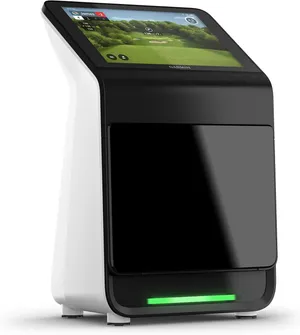
| Display | 10-in color touchscreen running the simulator on the unit; HDMI out |
| Battery | Up to 4 hours (maker rating) |
| Weight | 9 lb |
| Free to use | Practice and driving range on the unit's own screen |
| Course play | Garmin Golf membership (Home Tee Hero) ($99.99/yr). $99.99/yr for 43,000+ courses with putting, up to 4 players, on the built-in screen |
| Third-party software | GSPro, E6 Connect, Awesome Golf. Connects to GSPro, E6 Connect/E6 Apex and Awesome Golf over Wi-Fi; third-party licenses sold separately. |
| Works on | Standalone (simulator runs on the unit), HDMI to a projector or TV; Wi-Fi and Bluetooth |
| Warranty | 1 year (Garmin limited warranty) |
| 3-year cost | About $5,300: hardware plus three years of the cheapest course plan |
| Price tier | $$$ Premium ($2,500–$5,000). See Amazon for today's price. |
- Garmin lists 16.5 × 10.6 × 7.5 in, 9 lb, IPX3, up to 4 hours of battery, a built-in barometer and a 1080p-capable HDMI out (cable not included).
- Garmin publishes no numeric accuracy tolerance for the R50.
- The manual says you cannot charge it over USB-C; it uses its own AC adapter. Putting is disabled in weekly tournaments.
- Today's Golfer saw about 1 miss per 100 shots outdoors and warned that alignment can skew face/path by a few degrees.
- Amazon showed $4,999.99 sold by Amazon.com on Nov 12, 2026.
Specs come from the maker's manuals, FAQs and spec pages and from independent reviews; they can change with firmware and new bundles. Confirm what's in the box on the Amazon page before buying.
Garmin Approach R50 video review

Video by Breaking Eighty | Honest Golf Reviews on YouTube. Independent creator content, shown as a reference. It is not part of our scoring.
The Garmin Approach R50 is a three-camera launch monitor that is also the simulator. Home Tee Hero runs on its own 10-inch touchscreen, and an HDMI port sends the picture straight to a projector, with no PC or tablet in between. It measures spin directly, reports face angle and path, handles putting, and its course plan is $99.99 a year. It costs about $4,999.99 on Amazon (Nov 12, 2026; prices change), which makes it the most expensive standalone monitor we cover.
Who it’s for, and who should skip it
It’s for buyers who want premium camera accuracy with the least possible fuss: plug in a projector and play. Plugged In Golf called it the “most fun-to-use launch monitor I’ve ever tested.”
Skip it if club data is your priority. Plugged In Golf found the R50’s club data “hit and miss,” with angle of attack especially poor. Skip it if you’re on a budget: the FlightScope Mevo Gen2 costs about $1,149, and our Mevo Gen2 vs Garmin R50 comparison covers what the extra money buys. And note that for roughly the same $5,000, the SkyTrak ST MAX Studio bundles a monitor, enclosure, mat and projector.
Key capabilities
Three high-speed cameras capture the ball and club. You get measured spin, plus club speed, face angle, path, face-to-path and attack angle; face-to-path needs the included stickers (250 in the box). There’s no impact-location data, and the hitting area shrinks with club data turned on.
Garmin lists the unit at 16.5 x 10.6 x 7.5 in and 9 lb, IPX3, with up to 4 hours of battery, a built-in barometer and a 1080p-capable HDMI output. You can’t charge it over USB-C; it uses its own AC adapter. Putting works in the simulator, though it’s disabled in weekly tournaments.
Room and setup
The R50 sits about 1.5 ft to the side of the tee, facing it, at about the same height, with no leveling needed. Garmin publishes no room size. We use 13 ft as a working minimum: 8 ft tee-to-net from Garmin’s R10 manual, plus about 4 ft of swing room behind the ball and 1 ft behind the screen, per Carl’s Place. Carl’s Place’s general 15 ft minimum is the comfortable figure. Carl’s Place also allows a 9 ft swing area around the golfer for the R50, against 7 ft for most setups.
Try those numbers in the room size checker, and see our small-room guide if you’re tight on space.
Software and ongoing costs
This is the R50’s strongest card. Practice and the driving range run on the unit for free. Garmin Golf membership, $9.99 a month or $99.99 a year, adds Home Tee Hero with 43,000+ courses, putting and up to 4 players. Breaking Eighty reported in August 2026 that Home Tee Hero gained 15 “Enhanced Courses” (including Augusta, Pebble and TPC Sawgrass) at no extra cost.
If you want GSPro, E6 Connect/E6 Apex or Awesome Golf, the R50 connects over Wi-Fi; those licenses are separate. Over three years with Garmin’s plan, the total is about $5,300. That’s a lower running cost than Foresight+ on the Bushnell Launch Pro (about $494 a year for courses). See the subscription cost guide for every plan side by side.
Accuracy
Garmin publishes no numeric accuracy tolerance for the R50. Plugged In Golf found its ball data “almost perfectly in line” with a GCQuad, but club data hit and miss, and the 4-hour battery matched Garmin’s claim. Today’s Golfer scored it 4.5/5 after about 1,000 shots, calling it “very close” to TrackMan and GCQuad, with about 1 miss per 100 shots outdoors. It also warned that alignment can skew face and path by a few degrees, and listed the weight (over 4 kg), lack of strike location, stickers and proprietary charger as drawbacks.
What you’ll need beyond the box
- A projector and HDMI cable. The R50 drives it directly. The BenQ AH500ST (about $1,999) has 2D keystone for off-center mounting; the Optoma GT2300HDR (about $1,099) costs less. Our projector guide explains throw and brightness.
- An enclosure. The GoSports enclosure (about $999.99) or the Sturdum kit (about $499.99).
- A mat. With the SIGPRO Softy 4 x 7 (about $749.99), raise the R50 so it sits at about the same height as the ball.
- Club stickers (included) and a ceiling or floor mount such as the Mount-It! mount (about $36.99).
The setup cost builder totals it.
Bottom line
The R50 is the simplest premium simulator to run: cameras, screen and course software in one box, with a $99.99 annual plan and ball data that Plugged In Golf found almost identical to a GCQuad. Club data is its weak spot, and at about $5,000 before a screen, mat or projector, it’s a convenience purchase. If plug-and-play matters most, check the current price on Amazon.
Build a simulator around the Garmin R50
A launch monitor is one part of a home simulator. These are the parts we'd pair with it, all sold on Amazon. Check sizes against your room before you buy.
- EnclosureGoSports Golf Simulator Enclosure, frame + HD impact screen, 10 × 8 ftUniversal fit
A complete frame, impact screen and netting from a big-name net maker, sold and shipped by Amazon with 186 ratings. Also offered in 12 × 9 and 14 × 8 ft. Price shown is the 10 × 8 ft option; larger sizes cost more.
- Impact screenDurbles triple-layer golf simulator impact screen, 8.2 × 8.2 ftUniversal fit
A triple-layer replacement or DIY screen with grommets and bungee cords; the sound-damping middle layer is the point. Several sizes on one listing; measure your frame first.
- NetThe Net Return Home/Pro Series golf net, 8 × 7.5 ft, auto ball returnUniversal fit
The premium practice net: aluminum frame, S-shaped return that sends the ball back, and 4.8 stars from 348 ratings. A net, not a projector screen. The maker quotes 8.5 ft of hitting distance and a 9 ft ceiling.
- Hitting matSIGPRO Softy golf mat, 4 × 7 ft, 2.5 in foam coreUniversal fit
A joint-friendly premium mat with a replaceable hitting strip and real-tee support; the 4 × 7 ft size gives a full stance. 2.5 in thick: raise side-of-ball units (SkyTrak, Bushnell, Uneekor, Garmin R50) to mat height.
- Hitting matSIGPRO Softy golf mat, 4 × 10 ft (dual stance)Universal fit
The 10 ft version has stance zones on both sides, for households with left- and right-handed golfers. Side-of-ball monitors still need moving to the other side for lefties.
- ProjectorOptoma GT1080HDR short-throw 1080p projector, 3,800 lumensUniversal fit
The long-running budget sim projector: 695 ratings, low input lag and a 100-inch image from just over 3 ft.
- ProjectorBenQ TH671ST short-throw 1080p projector, 3,000 lumensUniversal fit
A zoom-lens short thrower (0.69–0.83) that gives more freedom in where you mount it; 4.7 stars from 682 ratings.
- MountMount-It! projector ceiling and wall mount, 40 lb capacityUniversal fit
An adjustable-arm universal mount for putting a short thrower on the ceiling, clear of your swing and the ball's path.
Checked November 2026. Price the whole build in the setup cost builder or browse every part in build your sim.
Featured in our guides
- The 8 Best Golf Simulators of 2026: Launch Monitors and Complete Packages, Ranked
- Best Golf Simulator Packages of 2026: All-in-One Kits vs Building Your Own
- Best Launch Monitors for Small Rooms and Low Ceilings (2026)
- FlightScope Mevo Gen2 vs Garmin R50 (and Mevo+ vs R50): Which Should You Buy?